Important Brain Structures

Click the button above for an interactive map of the brain. It describes the main functions and possible results when each area of the brain is damaged.
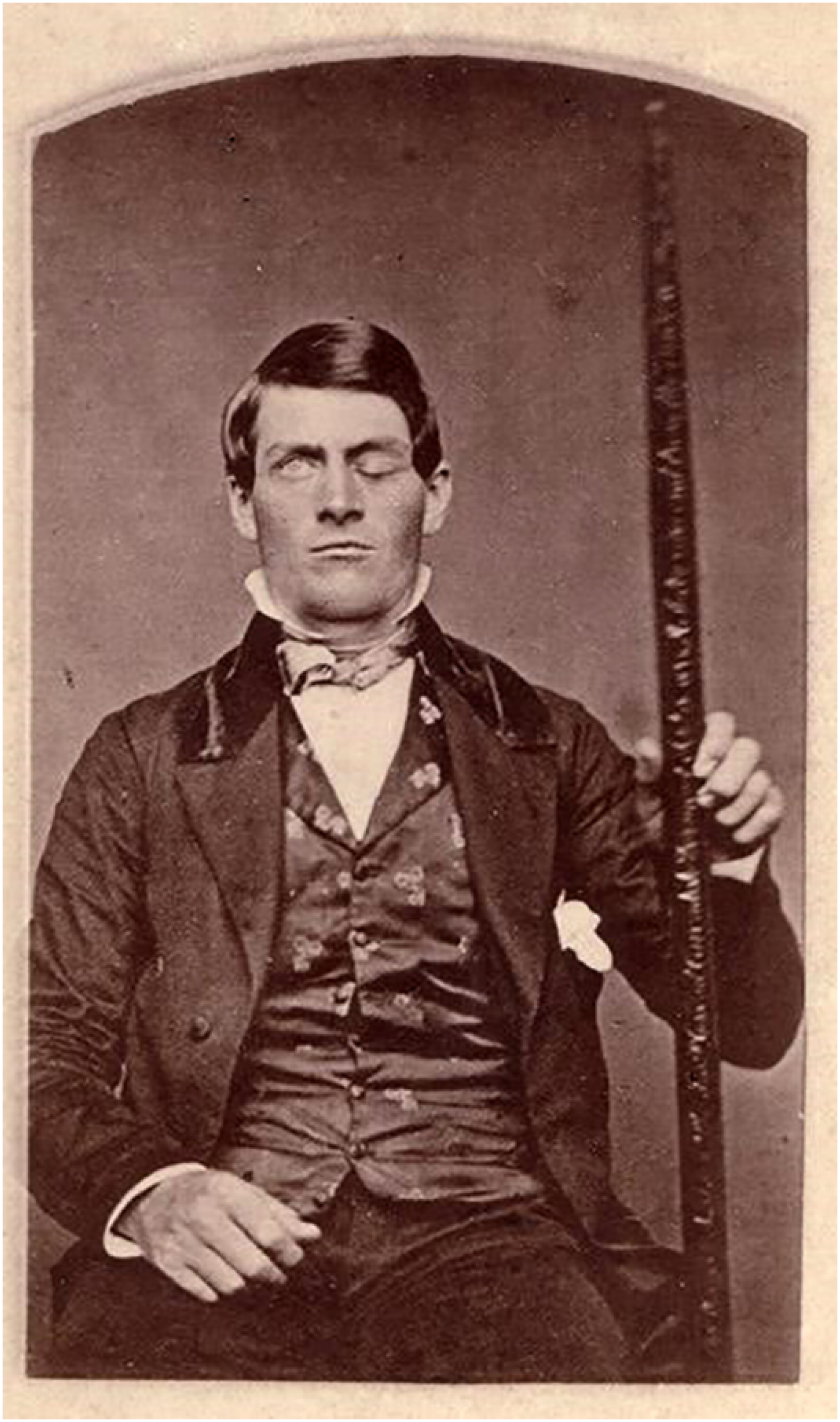
Phineas Gage
Phineus Gage, a man working in railroad construction was filling a hole with gunpowder and when sparks caused the powder to explode. The blast projected a bar a meter in length and 3.2 centimeters in diameter through his skull. It entered his left cheek, destroyed his eye, through the left front of his brain and out the top of his head.
He survived and woke up a few minutes later able to walk and talk. After some healing complications, it was apparent that the injury altered his personality. Before the injury Phineas was gentle and easy going but after he became rude, irrational, irritable, and had abandoned his plans for the future. His memory and cognition were not affected. After four years his old personality started to come through again, which shows that rehabilitation may be possible after traumatic injury.
Phineas Gage's case is possibly the first case to suggest that different areas of the brain play a role in determining personality and that certain parts, when affected, can lead to specific mental changes (Teles Filho, 2020).
Cerebellum-Enables motor coordination and balance and aids in sensory, spatial, emotional, and cognitive functioning
Frontal Lobes-Home to executive functions such as decision making. It is also our sense of self with aspects of our personality and temperament. The left side is crucial for speech.
Parietal Lobes-This area specializes in sensation and the location of our body parts The left side helps determine the location of objects in our environment. The right helps with locating and putting meaning to sounds as well as mathematical reasoning.
Temporal Lobes-These process sound and are involved in memory.
Occipital Lobes-This area of the brain processes visual stimuli and produces visual memories
Spinal Cord/Brain Stem-The brain stem carries messages from the rest of the body to the brain. *Fun fact: The sensory and motor pathways cross over here, meaning the right side of the brain is connected to the left side of the body and vice versa.
Page/Photo References:
Kiritsis, P. (2021). Parts of the Brain [Online image]. In Down the Rabbit Hole. http://paulkiritsis.net/down-the-rabbit-hole/The-Human-Brain-and-its-Primary-Divisions/
Teles Filho, R. V. (2020). Phineas Gage’s great legacy. Dementia & Neuropsychologia, 14(4), 419–421. https://doi.org/10.1590/1980-57642020dn14-040013
WETA. (2012, August 21). Interactive Brain - How Injury Can Affect the Brain | BrainLine. Www.brainline.org. https://www.brainline.org/tbi-basics/interactive-brain?gclid=Cj0KCQiAm5ycBhCXARIsAPldzoW1hnCLQKPGFRC2R5cy__2BFvJaAkazCppi-3b9dpDcMG8xV6ctQpMaAnt2EALw_wcB
Zimbardo, P., Johnson, R., & McCann, V. (2017). Psychology: Core concepts (8th Ed.) Prentice Hall
Create Your Own Website With Webador